Blended Learning in Mathematics, I’m not the only one doing it!

This week we were asked to explore an aspect of online/blended learning that we are interested in. As I am working on building a blended Calculus 30 course, I felt this would be a great time to read into how others are structuring blended learning of the mathematics variety. I should also warn you, this is a long post but, if you get through it, you will find my favourite definition of blended learning (thus far anyways).

13959196560_fae7ffcc02_z_d
Photo Credit

In my searching, I found a series of articles written by Birgit Loch, Rosy Borland and collaborative authors Liam McManus and Nadesda Sukhorukova for the annual ASCILITE conference. Their papers discuss a variety of ideas, implications and challenges around creating a blended mathematics course. In their first article, The transition from traditional face-to-face teaching to blended learning – implications and challenges from a mathematics discipline perspective (Loch & Borland, 2014), the authors discuss how mathematics is often overlooked for moving to a blended format for three reasons:

  1. Limited resources and cramped curricula.
  2. Instructor reluctance to move from the traditional “chalk and talk” as they have never experienced an alternative method of learning.
  3. The belief that mathematics is different from other disciplines and it doesn’t need to be re-invented through another method of instruction.

I have to admit, I am not going to argue any of these points but I may use them to help plead the case for blended learning. We have discussed in class about the cramped curricula and, to me, that is the ultimate reason why we SHOULD be moving to blended learning, allowing our students a better opportunity to have access to the teachers to help them with their learning. What better reason to try something new as “I’ve never seen anything else done”, I hardly think that “this is how it is has always been done” is a good enough excuse to not move to blended learning. And mathematics is definitely different than many other disciplines, Loch and Borland mention that mathematics is “complex due to the visual nature of the discipline” and recognize that the digital typesetting of mathematics can be difficult for students and instructors to communicate in short response times. With applications such as SeeSaw and FreshGrade where students are able to post pictures of their work, I’m not sure that this is completely valid, although I definitely think that timely feedback is still a challenge digitally. They also discuss the technology requirements for both students and instructors as well as a fear that by focusing on the online submission of assessments, “the development of deeper mathematical understanding that occurs during practice may be impacted as students may be ‘doing’ less mathematics because they no longer write it out” (Loch & Borland, 2014).

320px-aula_invertida
Micaelamolinagt, Aula Invertida, CC BY-SA 4.0

Loch and Borland go on to discuss the use of the flipped classroom and how it has developed a more active classroom, where students are able to “do” mathematics with the support of the instructor as opposed to this time being used for lecture. This allows for the concepts to be developed deeper. Within the flipped classroom, they recommend using audience response systems (such as Kahoot, Mentimeter, or Plickers) to help gauge student understanding and misconceptions but they question whether students with low prerequisite knowledge are truly capable of learning in this manner. Interestingly, they found that students that were in active learning classrooms were 1.5 times less likely to fail than those in traditional lectures (Freeman et al, 2014 via Loch and Borland, 2014).

While in the classroom, Loch and Borland discuss “board tutorials” where students work a problem together on a whiteboard, effectively “doing” mathematics together and collaboratively. This comment made me think back to my undergrad and Math 223 where we would often go to office hours and have our professor, Douglas Farenick, find us a large chalkboard to work the problem as a group. This course was one that challenged my thinking and caused me to struggle in mathematics (something that was new to me at the time) but when asked for help from a student, I look back at that and try to emulate it, as I find it was one of the most useful exercises I have done (thank you Doug if you read this).

The article is summed up with seven questions that the authors feel need to be further researched:

  1. What can we do to ensure students engage with both online content and classroom activities?
  2. How can we encourage school leavers enrolled in first year mathematics units to self-regulate their learning?
  3. How can we build in redundancies, eg. enable students to recover if they have not watched a video beforehand or have not attended class?
  4. What technology is needed to enable effective online communication and collaboration to support learning in Mathematics?
  5. What technology is needed to support deep learning of mathematics? What new technologies might be on the horizon? What impact can learning spaces have on student engagement?
  6. On a departmental level, what is the best approach for supporting teaching staff (including sessional staff) to develop and implement innovative pedagogy approaches, promote digital content creation and use technology to enhance learning and teaching outcomes?
  7. How do we measure the success of a flipped classroom?

The second article by these authors, Implementing blended learning at faculty level: Supporting staff, and the ‘ripple effect’ by Borland, Loch and McManus (2015) discusses question #6 above and the supports needed to implement blended learning at an institutional level and discusses many of the common themes that come up in our #eci834 discussions such as cost, accessibility, and professional development. What really jumped out at me from this article was the definition of blended learning that they chose to follow:

“an understanding of blended learning as being an approach which increases opportunities for students to engage with content and resources online in order to make more time available in face-to-face classes for active learning” (Borland, Loch, & McManus, 2015)

This definition really resonates with me, I value the face-to-face connections that I make with students and I like that their focus was to increase the effectiveness of this time, taking the lecture out of the face-to-face sessions and focusing on the student and their needs.

The third article, How to engage students in blended learning in a mathematics course: The students’ views by Loch, Borland and Sukhorukova (2016) addresses questions #1 and #3 from the above list, and do so from the perspective of the student. They state that students in blended learning courses need to be self-directed and self-regulated learners (they could use the skills from Twana’s post on online learning success strategies). Students in this study stated they like the face-to-face sessions because they were able to ask questions and gain further clarification on topics and it was found that students reacted positively to interactive and technology-enhanced classrooms where they were able to contribute in discussions with their peers (Donovan & Loch, 2013 via Loch, Borland, & Sukhorukova, 2016). Students were also honest, stating that they do not always watch as many recorded lectures as intended or even never watch them at all, students cannot be forced to engage in teaching activities of any sort if they do not want to. I appreciate this very open, honest, and abnormal statement in the article as too often we focus on being able to reach every child when, we know deep down, some are just not ready to be reached.

giphy
via GIFY

An aspect of a blended course that I did not think of until reading this article was the ability for the instructor to incorporate additional information on the “why” we are learning this, with students in the study stating that they enjoyed being able to get deeper into why we focus on a specific concept and its general use outside of the grading scheme for the course. This is a common question in my classroom and I like that blended learning provides a non-mandatory platform for students to pursue their interests in this way to gain a deeper understanding.

In discussing the motivation for watching videos ahead of class time, a variety of ideas were provided. The one I disliked the most: providing marks for watching the videos. Signing in to watch the videos does not mean that students are actually “watching” the videos, they can hit play, mute, and walk away, never gaining the understanding they should and receiving grades that do not reflect their understanding accurately. The one I like the most: recap the content at the beginning of class, using one or maybe two examples, and provide a plan for each class so that students know what they are missing if they have to. Recapping with a couple of examples helps instructors know where their students are in their understanding and allows for further instruction, if necessary, before the daily task is started.

giphy1
via GIFY

One major fault in blended learning as addressed in this article is that math is very hierarchical, constantly building on the content previously learned. If, when watching a video example, a student does not understand an early step, the entire video is lost, as is the time dedicated to it. This is something to consider in making videos for a blended learning course as you need to ensure you are being detailed enough that the weakest student in the class will be able to follow along, an perhaps may need to provide a review of prerequisite knowledge to help all students ensure they are confident in their solutions.

If you are still with me, congratulations, this has been a very long post and I am not quite done yet. In reading this, I am inspired to change not just my Calculus 30 course but by other mathematics courses as well, although I will wait until the fall semester to ensure I have had the time to adequately prep and organize my ideas in a meaningful and effective manner. In general, this is how I think I would like to set up my classes:

  1. Flipped classroom: Students are required to watch video of the examples with notes to follow along with before coming to class (such as how Ashley has described she runs her flipped classroom).
  2. At beginning of class, have a Plickers activity to determine how students are doing. This will require them to tell me if they are confident, need some clarification, or have no idea what happened.
  3. One to two examples on the board, so I can gauge where my students are. This will be followed by students asking specific questions on their current misconceptions.
  4. Group “Board Work” where students will be given a enrichment question and will need to come up with a solution collaboratively. I would like to play around with a presentation method similar to the interactive notebooks that Andy uses in his class, with some modifications.
  5. Work time for an practice questions. Or more time for enrichment. I am a firm believer in not everyone needs the same amount of practice to understand a concept and therefore do not require them to do all assigned textbook questions.

Well, I think that is it that I have to share, what do you think about this set-up for high school mathematics classes? Have you done something similar to any of the parts? What do you think of the findings of the articles? Let me know in the comments!

Feeling Alone on Audio- Island

This week, we were asked to reflect on Tony Bate’s chapter on the different types of media that can be used in the classroom. Initially, I thought I was right on board with many others such as Kelsie, Ashley, and Liz and that I prefer and learn best from text but as I was reading through the various other posts by our eci834 classmates, I realized that maybe I learn better through audio than I had thought.

6855179480_1084a63706_z_d
A Song of Ice and Fire via Flickr user Jemimus

I would like to address what Bates calls the unappreciated medium of audio. I love audio, and not just of the musical sort. About 2 years ago, I was encouraged by my sister-in-law to listen to the podcast Serial (Season 1) and I was very tentative to jump on board, I didn’t think that I would like just the audio. I had always had text in front of me before, I was sure I wouldn’t want to just listen to someone talk. The long, and uneventful drive from my home in Kipling to Regina that I was making at least once a week for classes was the reason I decided to try it out…and I LOVED IT! Now, it is a very interesting, even addicting, story (you seriously need to listen) which probably helped keep me interested but it made me think that this might be a good way to stay more up-to-date on my growing “to read” list. So, I downloaded Audible and decided to tackle a massive series, A Song of Ice and Fire by George R.R. Martin, all 201 hours, 41 minutes of it, and my love of audio was fully confirmed. Since finishing what has been published of that series, I have started to listen to some of the more classic works on my list, The Prince by Niccolo Machiavelli, Frankenstein by Mary Shelley, and I am just about finished The Divine Comedy by Dante Alighieri.

My love of audio goes further than just listening to content. I find I focus better when I am listening to something, even if I am trying to read. While reading Bates’ Chapter 9 for this week’s class, I was listening to Spotify’s Intense Studying playlist., it helps keep me focused and minimizes the distractions around me.

6243624732_3bea3ec738_d
Academic reading process Photo Credit: Nina A.J. Flickr via Compfight cc

Even though I enjoy audio, when I comes to what may be considered more academic reading, I still think I prefer text. Andrew‘s approach of which medium is the best for him is probably closest to my overall views of media. It depends on mood, topic, and the quality of the resource. Liz mentioned that she often writes and highlights all over text that she reads and I do the same. Last semester I took EADM 814 and found that I had notes, questions, and definitions jotted everywhere to ensure that I understood the cases we were studying. In this course, I struggle not to print the textbook readings so that I can make my notes in the sidelines. Luckily, I have found that Evernote is helping me break free of my not so eco-friendly habits.

Video is, of course, an amazing media to use when teaching as it can incorporate the audio and the text features along with visuals. Angela and Chalyn describe the way that video integrates all of these mediums.

What do I use when I teach? I use a blend of all three. I agree with Jannae that in teaching math, especially at the high school level, there is a need for text in the form of mathematical symbols. But I also describe what I am doing in each step of my work as we go through examples and I encourage my students to do the same. Bates references this stating that “explaining or ‘talking through’ materials presented through text, such as mathematical equations, reproductions of paintings, graphs, statistical tables, and even physical rock samples” can be “particularly ‘potent'” (Bates, 2015, 7.3.2). At the end of a concept, I try to incorporate a video that is well done and applicable. Much like Logan, I think I integrate both the text digitally on my SMART Board and the audio in the form of lecture and video.

It seems I am a part of a very small group of audio-lovers. Are you tentative like me to jump in or have you had a bad experience? Would you consider it for the “right” topics?

Rapping Math Concepts – WSHSmath Video Review

For this week’s blog, we were asked to either critique a unit of instruction done by someone else, or to use one of the content creation tools that we discussed to create our own content. I have decided to do both.

Like Andrew mentioned in his post Crash Course – 7 Thumbs Up!, I also like to use videos in my teaching for both learning a new concept as well as for review. I am a huge fan of the Crash Course videos as well as I use historyteachers as they present the information in a unique manner and give students another perspective or way of viewing things that help the importance of what we are discussing sink in.

As a math teacher, finding videos that are not super cheesy but that are mathematically sound is not an easy task. I also try to stay away from videos that fall into the “math is not cool” or “wow that person is a nerd” stereotype such as Mathmaticious. That is why I was pumped when I stumbled across WSHSMath‘s channel. They only have 7 videos but they are QUALITY. They are created by a group of teachers at Westerville South High School in Westerville, Ohio. The next video that I will be using in my classroom is the factoring video.

I love that they remake popular songs and sing/rap about mathematics concepts. This is Teach Me How to Dougie by Cali Sway District, but they also use Yeah! by Usher, Gettin’ Jiggy Wit’ It by Will Smith and Call Me Maybe by Carly Rae Jepsen. They have their students in their videos as well. I find that this helps my students relate more as they can see people their age involved and engaged in the content (not to mention, some of them have some sweet dance skills).

These videos are catchy and educational, I will often hear students in the hallways humming the melodies after watching the video in class. (I am sure they are not thinking the “math lyrics” but a teacher can only hope!)

So, how hard would these be to recreate by the “average” teacher?

15189303264_acd2284885_m_d
Photo Credit: ToGa Wanderings Flickr via Compfight cc

Personally, I do not have a singing voice nor am I very good with the remixing of the lyrics. To recreate an entire song would probably take me weeks or months of trying to make it work and sound good. I would say that these three gentlemen are masters of the parody of lyrics, but, that doesn’t mean it is out of reach for the average teacher, just maybe for me.

Their students are amazing. I am pretty sure that I could convince my students to join me in making a video such as this if I had the right “motivation” (which could be as simple as a candy at the end). If you are passionate about your project, I think that most teachers would be able to gain a dancing posse for videos such as these.

posse
Screenshot from Urban Dictionary

So what about the graphics? This is where I am going to try to out a new tool! I am going to try to recreate some of the graphics in the video Teach Me How To Factor (above).

The Difference of Squares example

I did not rap, but I did go over the example in a (not very catchy) way. The graphics were not very difficult. I used SMART Notebook and SMART Recorder to take the video.

Overall, I think that this would be an achievable goal for many teachers. And, knowing how my students react to these videos, I think that it holds a lot of value for students. It is not a lesson in itself as many of the videos glaze over some of the key things that are needed for understanding but as a review, I feel that they have done an amazing job of their videos!  What do you think?

When I started to recreate the graphics, I really tried to used Screencastify but it repeatedly froze my computer for some reason. I will try again in the future but for now, I will settle for using SMART products instead of more “open” options. I am also very intrigued by Audacity for my Social Studies classes I did record myself reading out of a mathematics book that I own A Curious History of Mathematics by Joel Levy and will probably be playing around with that in the near future.

UPDATE: I have figured out Screencastify and have made a how-to video of me uploading files to Canvas in the modules. More work to come on organizing the course!

Yet another on the Canvas….

I am jumping on board the Canvas-wagon along with many others in ECI834 such as Carla, Sarah, Nicole, and Andy. (I would love to say that was an intentional pun, but I didn’t realize what I had done until after I had typed it….).

2382571021_d33f86ce9d_d

All enthusiasm for making this decision aside, I am not feeling 100% confident with the choice as I am not sure it will be as interactive as I would like it to be. When we were first given the assignment to create a blended/online course prototype, and seeing how our course was set up in Google+, I was excited to try and set up my course in a similar fashion. Then, after being inspired by Carla’s post Inspired by Something New, I decided to look at Canvas…and now I am torn.

3o7tkkty25k66hhlby
What to do…. via GIFY

I have had some time to “play” in Canvas and have set up a REALLY rough course (I’m talking, the text/content is along the lines of “asl;dkgal;skdfha;” and not even a nice lorem ipsum) and I have come to the following conclusions:

24277461726_374a79a5cc_d
Photo Credit: The Daring Librarian Flickr via Compfight cc

1) I like the Calendar. I am a big fan of planning using a calendar and, if you were to see my long-term planning for this semester’s Calculus 30 course, you would see I have every class planned as to what I will be covering. This does not mean that there is no flexibility but it is my way of ensuring that I cover the entire course, and I like to give students an outline of when all of their exams will (likely) be the first day of class, especially because it is essentially a distance course.

2) The Modules allow for easier navigation than what I was thinking Google+ would provide. This is probably one of the more important aspects that is driving me towards using Canvas as I feel my students will use it ONLY if it is easy to use, I plan to set up my units/outcomes as my modules so that students can easily find what they are looking for.

3) The Quizzes feature allows for more detailed feedback than a right/wrong. Kyle discusses this further in his post this week. Because of the content and delivery method this course has typically had for me, I only grade the unit and final exams to determine the students’ grade. (I know, not the “best” but this was actually a request from the students as assignments were “too much course load”). I would like to use the quizzes as a way to bridge the gap between the students that REALLY want the assignments and feedback and the ones that have enough on their plate with their daily practice.

2
Screenshot

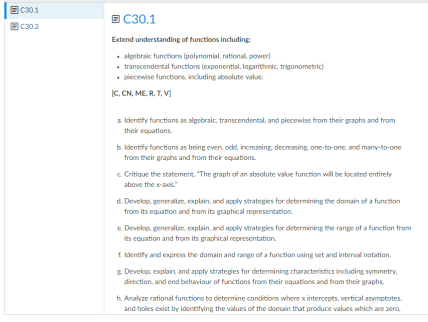
4) I can post the Outcomes right within the course….although I am not sure about the rubric/grading yet. Until I have a little more time to figure that aspect out, I probably will not use it extensively but I look forward to be better at it. I also like that you can connect/link these outcomes to specific assignments. Although I did not find the Saskatchewan Curriculum outcomes, this is something that can be added.

Overall, I find the platform to be easy to navigate and use. I am not done experimenting with some of the aspects and look forward to having it “in-action” with my students like Sarah, and Carla are intending to do and, much like Carla, I have a group of students that will not be shy in letting me know if something isn’t quite right.

“The Learning Management System. The LMS. Or in the UK, the VLE. The Virtual Learning Environment. Even though the latter sounds much less foreboding and controlling than the former, I confess: it makes no difference. I am not a fan.” – Audrey Watters on her blog

After all of my experimentation, I then read Audrey Watters’ post Beyond the LMS. As stated in her post, the LMS is about management and not about the students. Students (and teachers) often lose their work after the course is complete and are no longer able to access what they have created. This takes me back to Google+ and creating a space where the students can continue to be connected AFTER the course is done (if they choose), and maybe even help each other as they move forward into various post-secondary pathways.

So, back to square one. In all reality, I think that I am going to use both. Canvas to house the “meat” of the course, and Google+ to encourage the interactivity between my students and as a quick place they can go for answers. Or maybe, with the right convincing, I will be bold enough to leave the Canvas behind and go Google all the way…..

3oft5rjqq7zuyq7hqe
Leaving… via GIFY

Choosing the content is INTEGRAL to creating an online/blended course

When given the course prototype assignment for EC&I 834, my mind initially started racing….which course should I do, should I try more than one, are certain courses too hard and to be avoided…and, most prominently…. OMG where do I start??

29292593605_baa6140d10_m_d
Too many ideas?

Photo Credit: danielfoster437 Flickr via Compfight cc

As I teach in rural Saskatchewan, we are unfortunately not always able to offer students the courses they would like to take in a face-to-face manner. We have come up with unique ways to get around this, primarily with our magnet system. Our magnet system involves schools that are relatively close geographically to each other offering a selection of courses that may not have enough interest in only one school. These are primarily PAA courses, however we offer French, Calculus and Forensic Science in this manner as well. Every second afternoon, students are transported via buses to the appropriate school to take their magnet course, which are blocked in 2-hour time slots, and then are returned to their home school before the end of the school day. Students are required to travel over their lunch hour but, through this programming, we are able to increase their options from 4 courses to 10 courses in my particular magnet grouping.

I teach the Calculus 30 course for my magnet grouping and have had to adapt an academic course into a 2-hour block where (not all) students are not able to stay for extra help if needed. I have had to come up with alternative ways of aiding students, typically this means they email me questions, I work them out, and email an image of the fully worked solution back. This is not the ideal way to receive additional support in mathematics and therefore, I would like to create a space where students are able to interact with each other and with myself to work through their challenges in the course. Calculus is often thought of as the study of change, and so I feel will be a great place for me to start my journey into online and blended learning.

5633007409_28c34181d5_d

Photo Credit: CMLorenz16 Flickr via Compfight cc

So, I have selected the course, Calculus 30, and am thinking that a blended learning model, with both face-to-face and online aspects, will be the best for the course content and student needs. Now, I just need to find an appropriate learning management system (LMS). I have read that other classmates (Liz and Kelsie) are looking at using Google Classroom and other GAFE tools which I do not have access to as my division has not yet been ready to jump on board with them. So I am looking for another LMS. I have created a course using Moodle in the past, but am looking to expand my horizons into something new! Amy tweeted asking for suggestions for elementary LMS and I am going to start looking at the suggested Edmodo and Fresh Grade and move from there. Any and all suggestions, with a major bonus if they support math text, are welcomed!

I would like to try a flipped classroom model but am not sure that I would like the entire course/module that I will create to be flipped. Including videos of myself working problems that will be accessible for students working at home who, in the past, may not have had access to someone that could help them when they get stuck may be how I attempt this. If you have done a flipped classroom, what have you found to be the benefits/challenges of the set up?

If there is anyone that is still trying to decide what course they would like to create and would like to share in my passion for Calculus, let me know, I would love to collaborate if someone else is interested in the same topic! I look forward to creating this prototype course and hopefully adapting aspects of it into more of my teaching!

Now to try something new….embedding a GIF…..

3oedv8etnvogpos18i
Aaaand I’m out… via Giphy


WARNING: The following may describe a passionate math-geek. Reader discretion advised.

Hello! Welcome to the blog of an absolutely passionate math-geek of a teacher! This is my journey through EC&I 834 and the world of creating online and blended learning courses.

My name is Kara Taylor and I am a teacher at Kipling School in Kipling, Saskatchewan. I grew up primarily in rural Saskatchewan and am happy to be able to work in a small town although, working in a Pre-K to Grade 12 school, that often means that my course load changes drastically year to year. I primarily teach senior math and history courses but I have taught a variety of other courses including science, accounting, and physical education (to name a few) ranging from grades 5-12. I am also the Career Counsellor for my school so I get to work with students who are choosing their future career pathways and help them to achieve their goals! Within the school I also coach Sr. Boys Volleyball and Track and Field.

I live with my wonderful husband, our fur-baby Isabella (Bella for short) and our slightly spikier-baby Felix. Some of my hobbies include volleyball, reading, hunting, fishing, outdoor adventures, playing cards and board games, and travelling. Travelling is especially important to me as my niece and nephew live in Mildenhall, UK and we do not get to see them very often during the school year so we try to visit during the summer!

My three goals for learning in this class:

  1. Become a better blogger. I have tried blogging in the past and took a course with Alec in my undergrad where I was in the habit of blogging regularly but have been unable to continue this while working as a teacher. I would love to get back into the swing of things and use blogging as a platform for my personal reflections and growth through my teaching career.
  2. Learn about various tools that can be used to create, deliver, and generally house online and/or blended learning courses. In one of my roles in my division, I have helped to develop an online Workplace and Apprenticeship 10 course and our group is now working on the 20-level course. This is being done using Moodle however I feel there are other platforms that may be more conducive to a mathematics course and I am excited to explore and evaluate these tools so that I may be able to bring my knowledge back to our “Moodle team” and make our courses better.
  3. Create a module/course that is appealing to students and that I can build on in the future. Teaching in a rural setting, my school is limited in the options that our students are given in terms of courses offered and I feel that this is where online courses can really benefit our students. I want to become comfortable in creating courses in a variety of disciplines and knowing which tools are better suited to which disciplines as what may work for mathematics may not be a good platform for social studies. I want my module/course to be something that I can grow and develop further to give my students more options and be comfortable with the tools so that I can make online courses for the various different courses that I teach. Most importantly, I want to create something that my students would actually WANT to use and be happy to learn through. I am lucky to have students that will give me honest suggestions about what they like and not like and I look forward to integrating the tools we learn about and what students want to see in an online course into one!

An “about me” post would not truly describe me without some form of math-based video SOOO…. in honour of the fact I will start trigonometry with my Workplace and Apprenticeship 10 course on Friday, one of my favourite videos on the subject can be found here: https://youtu.be/t2uPYYLH4Zo. This group of teachers makes awesome math videos and students enjoy watching them as well!